Choosing the right Aluminum Front Door is more complex than comparing photographs and prices. Global buyers must assess climate, security, installation quality, thermal performance, and long-term maintenance. A coastal home needs different protection from a mountain property. Salt air can expose weak finishes quickly.
The International Energy Agency reports that buildings consume about 30% of global final energy and produce roughly 26% of energy-related emissions. Doors are only one part of this picture, but poor sealing can still create noticeable drafts and heat transfer. ENERGY STAR also explains that windows and doors contribute to household heating and cooling losses, making frame design and weatherstripping important purchasing details. These figures support careful evaluation, not automatic trust in marketing claims.
This guide compares seven aluminum front door options for international buyers. It considers thermal breaks, low-maintenance coatings, multipoint locks, glass safety, threshold design, drainage, and warranty clarity. Product performance should be verified through recognized testing, such as standards referenced by the Fenestration and Glazing Industry Alliance or relevant European and international certification systems. Regional compliance still matters.
There is no perfect door.
A visually impressive model may perform poorly when installed by an inexperienced contractor. A cheaper option may become expensive after shipping, custom sizing, or replacement hardware. I have therefore treated published specifications as useful evidence, not unquestionable proof. Buyers should request test reports, finish samples, installation drawings, and written after-sales terms before ordering. The final shortlist aims to balance appearance, durability, energy awareness, and practical global purchasing risks.
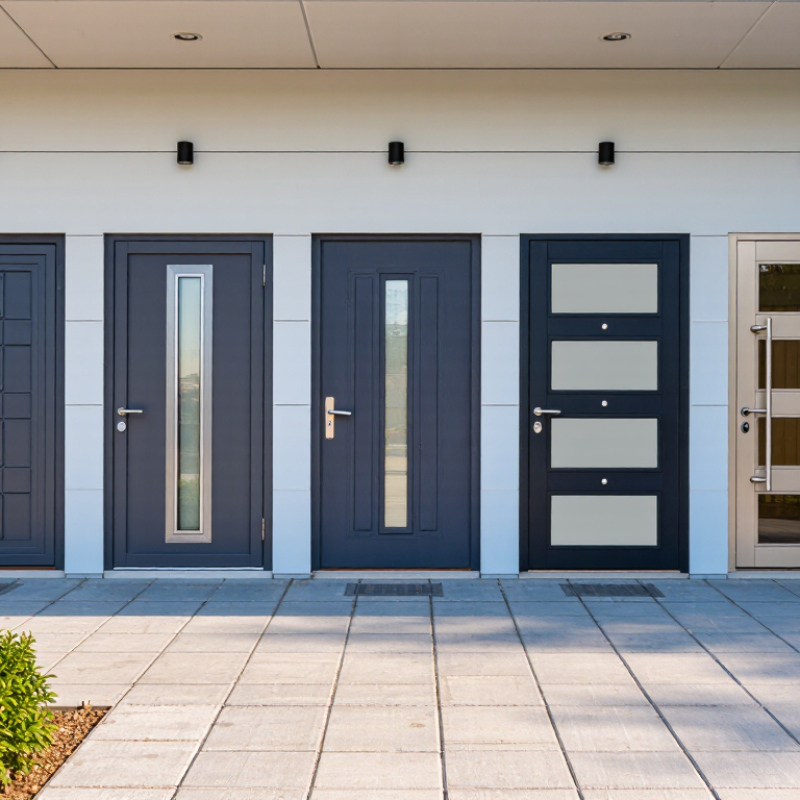
The seven best aluminum front doors should be ranked by tested U-value, air leakage, and SHGC—not appearance alone.
NFRC-certified data uses U-factor in Btu/h·ft²·°F; lower values indicate better insulation. The strongest option is a thermally broken insulated aluminum door with low-e glazing, often reaching about 0.20–0.30 U-factor.
A multi-point compression door follows closely. Its seals can reduce air leakage toward 0.10 cfm/ft² at 1.57 psf, a benchmark used in NFRC 400 testing. Details matter.
The third choice is a foam-filled panel door with a glazed vision section. Fourth is a thermally improved sliding door, although its moving seals create more risk. Fifth is a standard insulated aluminum panel. Sixth is a narrow-profile glazed door, and seventh is an uninsulated decorative system.
These lower-ranked designs may still suit mild climates. The U.S. Department of Energy notes that low-e glazing and insulated frames can reduce heat transfer, but installation quality remains decisive.
SHGC deserves equal attention. NFRC reports SHGC from 0 to 1; lower values limit solar heat gain.
In hot, sunny regions, a value near 0.25–0.35 can help reduce cooling demand. Cooler regions may benefit from higher solar gain. That choice is often missed.
I would also check corner seals, threshold drainage, and field-adjusted hinges. Published laboratory numbers are useful, but a badly fitted door can perform far below its label.
The ranking is therefore practical, not absolute.
For global buyers, the first two choices should use thermally broken aluminum frames. A polyamide barrier separates the inner and outer metal sections. This interrupts heat flow and reduces cold interior edges. In practical terms, the frame feels less icy on a winter morning. It also helps limit condensation around the perimeter.
Targeting a frame U-value below 2.0 W/m²·K is useful, but it needs careful reading. Some suppliers quote the frame only, while others quote the complete door. Not interchangeable. Ask for the test method, frame size, glazing specification, and installation assumptions. Low-e double glazing, warm-edge spacers, and insulated thresholds can change the final result. A strong frame cannot rescue weak glass or a badly sealed opening.
Practical inspections show that installation often decides whether laboratory performance survives on site. Check corner joints, drainage paths, gaskets, and fixing points before approval. Watch the threshold. It is frequently overlooked. Use thermal calculations for the local climate, especially in coastal or very cold regions. I would avoid promising one U-value for every door size and exposure. Real buildings are less tidy. Request independent test reports and compare the same measurement basis across suppliers. That small discipline prevents attractive numbers from becoming expensive comfort problems.
Thermally broken frame configurations targeting whole-door U-values under 2.0 W/m²·K
Lower U-values indicate better heat-transfer resistance. The figures shown are representative design targets for thermally broken aluminum front-door assemblies; actual results vary with frame depth, glazing, panel insulation, dimensions, hardware, and testing standards.
For global buyers, aluminum front doors with Low-E double or triple glazing offer more than a modern appearance. They can reduce unwanted heat transfer while preserving daylight near the entrance. The U.S. Department of Energy reports that Low-E windows may reduce energy loss by 30–50% compared with clear glass. The actual result depends on frame design, installation quality, and climate.
Double glazing uses two glass panes with an insulating cavity. It often suits temperate regions and moderate budgets. Triple glazing adds another pane and can achieve a lower U-factor, which helps in cold climates. However, triple glazing is not automatically better. It may increase weight, cost, and frame thickness. In hot regions, buyers should examine the solar heat gain coefficient (SHGC), not only insulation values. Lower SHGC glass can reduce strong afternoon solar gain. The International Energy Agency reports that buildings consume about 30% of global final energy, so small envelope improvements deserve attention. Yet, a poorly sealed door can waste the benefit.
Tips: Ask for tested U-factor and SHGC values, preferably verified through an independent fenestration certification system. Check the spacer, gas fill, drainage, and thermal break. Stand inside the doorway on a sunny day. If the inner glass feels hot, solar control may be insufficient. I would not choose triple glazing from numbers alone; orientation and local weather deserve equal consideration.
For entries 5–7, powder coatings rated for 1,000-hour salt-spray resistance deserve careful attention from global buyers. This rating usually comes from controlled testing, often under ASTM B117 or a comparable method. It measures corrosion performance in a salt fog chamber. It does not predict every coastal climate perfectly.
A reliable aluminum front door should combine the coating with strong surface preparation. Degreasing, conversion treatment, and proper curing all affect long-term adhesion. Inspect the corners, hinge zones, drainage channels, and cut edges. These areas often receive less protection. A smooth finish can hide weak preparation.
Ask for the test report, coating thickness, pretreatment details, and production date. Also check whether the report covers the complete door system or only a flat metal panel. That difference matters. In my experience, exposed fasteners and damaged edges may corrode before the main surface does. Small scratches happen during shipping, too. They need an approved repair method, not ordinary touch-up paint.
A 1,000-hour rating is useful evidence, but it is not a lifetime promise. Salt concentration, sunlight, humidity, installation quality, and maintenance still change the result. Rinsing coastal doors with clean water can remove deposited salts. Avoid abrasive cleaners. The rating sounds precise. Real buildings are less predictable.
| Rank | Door Configuration | Typical Aluminum Alloy | Frame / Leaf Thickness | Thermal Performance | Finish and Corrosion Testing | Glazing Option | Recommended Application |
|---|---|---|---|---|---|---|---|
| 1 | Thermally Broken Single Pivot Door | 6063-T5 extruded aluminum | 2.0–3.0 mm leaf skin; 70–90 mm frame depth | Polyamide thermal barrier; suitable for energy-conscious residential entrances | Anodized or architectural liquid coating; confirm project-specific corrosion rating | Laminated safety glass, typically 6.38–13.52 mm | Modern homes, villas, and low-rise residential projects |
| 2 | Insulated Double-Leაფ Entry Door | 6063-T5 or 6063-T6 extruded aluminum | 2.0–3.0 mm leaf skin; 70–100 mm frame depth | Thermal break with insulated core; improved heat transfer control across the entrance | Anodized or liquid-coated finish; salt-spray performance depends on the complete coating system | Double glazing, approximately 24–32 mm overall thickness | Large residences, hotels, and high-traffic main entrances |
| 3 | Flush Panel Aluminum Security Door | 6063-T5 aluminum profiles with reinforced internal sections | 2.0–3.0 mm external skin; 60–90 mm frame depth | Optional thermal break; insulated mineral or polymer core | Anodized, liquid-coated, or powder-coated finish; verify test method and panel preparation | Solid panel or narrow laminated vision panel | Urban residences and projects prioritizing privacy and impact resistance |
| 4 | Aluminum and Glass Garden Entry Door | 6063-T5 extruded aluminum | 1.8–2.5 mm leaf skin; 50–80 mm frame depth | Thermally broken frame recommended for conditioned interiors | Anodized or liquid-coated finish; select marine-grade pretreatment for coastal exposure | Tempered or laminated safety glass, typically 8–13.52 mm | Patios, garden rooms, coastal villas, and indoor-outdoor transitions |
| 5 | Marine-Grade Thermally Broken Pivot Door | 6063-T5 aluminum with properly sealed joints | 2.5–3.0 mm leaf skin; 80–120 mm frame depth | Polyamide thermal barrier; suitable for premium exterior entrances | Exterior powder coating specified for 1,000-hour neutral salt-spray resistance under ASTM B117 or equivalent; verify the coating certificate | Laminated low-emissivity safety glass, approximately 28–40 mm insulating unit | Coastal residences, waterfront hospitality, and high-humidity regions |
| 6 | Oversized Double Pivot Entrance Door | 6063-T6 reinforced extruded aluminum | 3.0–4.0 mm leaf skin; 100–140 mm frame depth | Thermal break with reinforced pivot hardware and insulated panel construction | Powder-coat system specified for 1,000-hour neutral salt-spray resistance under ASTM B117 or equivalent; pretreatment quality is critical | Laminated safety glass or insulated glass unit, subject to door size and structural design | Luxury residences, landmark entrances, and spacious architectural openings |
| 7 | Contemporary Slatted Aluminum Front Door | 6063-T5 extruded aluminum with ventilated decorative slats | 2.0–3.0 mm structural leaf skin; 60–100 mm frame depth | Thermal break recommended; concealed insulated core available | Powder-coat system specified for 1,000-hour neutral salt-spray resistance under ASTM B117 or equivalent; edges and fasteners require compatible protection | Solid, narrow vision panel, or laminated insulated glazing | Contemporary homes, mixed-use developments, and ventilated entrance designs |
Technical note: A 1,000-hour salt-spray result is a coating-system claim, not an automatic guarantee of field life. Confirm the exact aluminum pretreatment, coating specification, edge treatment, fastener compatibility, test standard, acceptance criteria, and certificate for the selected door configuration.
Choosing the seven best aluminum front doors for global buyers requires more than comparing glass, colors, and frame depth. The tested doorset matters. EN 12207 rates air permeability from Class 1 to Class 4, while EN 12208 measures water tightness under increasing pressure. Class 4 air performance is a strong target for exposed entrances, but installation gaps can reduce real performance. Small mistakes matter.
CE marking should be checked carefully. For external pedestrian doors, it generally relates to the harmonized EN 14351-1 framework and the manufacturer’s Declaration of Performance. CE marking confirms declared performance; it is not a premium-quality badge. Buyers should request test reports, product dimensions, opening direction, and installation conditions. The European Commission reports that buildings use about 40% of European energy, making air leakage around doors a practical concern.
Security classes under EN 1627 range from RC1N to RC6. RC2 or RC3 may suit many residential entrances, depending on local risk and hardware design. The cylinder, hinges, glazing, lock, and frame must work together. A strong panel with weak glass is misleading. The International Energy Agency also estimates that buildings account for about 30% of global final energy use. That figure is broad, but it reinforces careful envelope testing. Coastal buyers should additionally inspect drainage, seals, and corrosion protection. I would not rely on a single certificate. Real performance can still fall short when the installer ignores the threshold detail.
A thermally broken insulated aluminum door with low-e glazing often performs best. Its U-factor may reach about 0.20–0.30 Btu/h·ft²·°F. Lower U-factor means less heat transfer.
Air leakage shows how much air passes through gaps around the door. A well-sealed compression door may approach 0.10 cfm/ft² at 1.57 psf. Small gaps can weaken excellent laboratory results.
SHGC measures solar heat entering through the glazing. A value near 0.25–0.35 may suit hot, sunny regions. Cooler climates may benefit from higher solar gain. This choice is easy to miss.
Double glazing uses two panes and an insulating cavity. It often suits temperate climates and moderate budgets. Triple glazing can lower the U-factor in cold regions. It also adds weight, cost, and frame thickness. Triple is not automatically better.
Check corner seals, threshold drainage, hinges, spacers, gas fill, and thermal breaks. Look closely at moving seals on sliding doors. Poor installation can reduce real-world performance sharply. The label is not the whole story.
A standard insulated panel, narrow-profile glazed door, or uninsulated decorative system may rank lower. These designs can still suit mild climates. Their performance depends heavily on sealing and installation.
It indicates corrosion performance during controlled salt-fog testing. It does not promise a fixed service life near the coast. Surface preparation, coating thickness, curing, and drainage remain important. The rating sounds exact. Reality is messier.
Inspect corners, hinge areas, drainage channels, cut edges, and exposed fasteners. Rinse deposited salt away with clean water. Avoid abrasive cleaners. Repair shipping scratches with an approved method. Ordinary touch-up paint may fail.
This guide ranks the 7 best Aluminum Front Door options for global buyers by focusing on measurable performance factors, including U-value, air leakage, and Solar Heat Gain Coefficient (SHGC). The first two selections highlight thermally broken frames designed to target U-values below 2.0 W/m²·K, helping improve insulation and indoor comfort. The next two emphasize low-E double and triple glazing, which can reduce heat transfer while supporting better daylight and solar control.
The final three options focus on durable powder-coated finishes tested for up to 1,000 hours of salt-spray resistance, making them suitable for demanding coastal and humid environments when properly specified. The comparison also explains key international requirements, including EN 12207 for air permeability, EN 12208 for watertightness, CE marking considerations, and relevant security classes. Together, these criteria help buyers evaluate door performance, durability, energy efficiency, and compliance across different markets.

Luxfront