Choosing an Aluminum Entry Door manufacturer requires more than comparing glossy catalogs and attractive project photos. Global buyers must examine alloy quality, thermal breaks, drainage design, hardware durability, finish performance, and documented testing. A door may look impressive in a showroom, yet fail under coastal salt, freezing temperatures, or repeated commercial use. Small details matter.
Fenestration expert Joe Altieri offers a practical warning: “A door is only as reliable as the details around it.” This principle guides our review of leading manufacturers. We consider manufacturing experience, export capability, product customization, quality control, certification, and after-sales support. Reliable suppliers should explain their aluminum grade, coating process, glass options, installation requirements, and warranty terms clearly. Vague answers deserve caution.
No ranking is perfect. Buyer priorities differ. A hotel near the sea may need stronger corrosion resistance, while a residential project in a cold region may value thermal efficiency. Some manufacturers excel at large pivot doors, but provide limited service support overseas. Others offer competitive pricing, yet lack transparent test documentation. This guide compares the strengths and limitations of top Aluminum Entry Door manufacturers for global buyers. It also encourages practical verification through factory audits, sample inspections, reference projects, and written performance data. Good decisions often come from asking uncomfortable questions before placing an order.
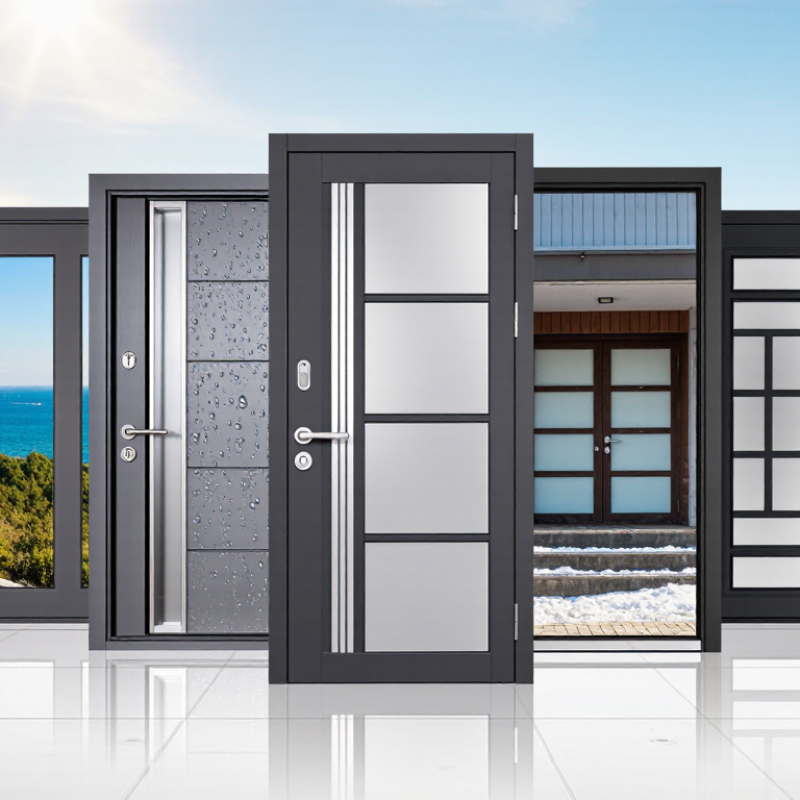
For global buyers, a leading aluminum entry door manufacturer must offer more than attractive product images. It should understand climate, building practices, and regional compliance requirements. Experienced manufacturers provide alloy details, coating specifications, hardware options, and installation drawings. These documents reduce uncertainty during purchasing. Details matter.
Production quality should remain consistent from the first sample to the final shipment. Reliable factories control aluminum thickness, corner joints, thermal breaks, gasket compression, and surface treatment. A well-made door should open smoothly, close evenly, and resist water entering around the frame. Independent testing can verify air leakage, water penetration, wind pressure, and repeated operation. These results are more valuable than general quality claims.
Communication also defines a serious manufacturer. Clear lead times, packaging photographs, inspection records, and traceable batch information build practical trust. Strong suppliers ask about wall thickness, threshold height, handle position, and local weather conditions before quoting. That is not always convenient. However, rushed quotations often create expensive changes later. Even experienced buyers can overlook drainage details or hinge loading. A careful manufacturer raises those issues early and accepts reasonable revisions. Its technical team should explain limitations honestly, instead of promising every custom feature. Reliable after-sales support matters too, especially when replacement hardware or adjustment guidance is needed across borders.
A leading manufacturer should demonstrate verified durability, consistent production quality, and compliance with international performance standards. The chart below shows the EN 12400 durability classes used to evaluate door operating cycles.
How to read the chart: Higher cycle counts indicate greater tested operating durability. These are standardized reference thresholds, not company or brand claims, and should be reviewed alongside thermal insulation, air permeability, water tightness, security, and warranty performance.
For global buyers, a capable aluminum entry door manufacturer should explain every production stage clearly. The process begins with alloy selection, usually based on strength, corrosion resistance, and local climate. Engineers verify the alloy temper before extrusion. Extrusion dies shape the frame profiles with consistent dimensions. Thermal-break polyamide strips reduce heat transfer through the frame. Small deviations can still affect installation.
After fabrication, surfaces are cleaned, treated, and powder coated under controlled conditions. Technicians check coating thickness, color consistency, and adhesion. CNC machining creates accurate openings for locks, hinges, and drainage channels. Assembly teams then install seals, glass, hardware, and threshold components. Proper gasket compression helps prevent drafts and water entry. It must be checked manually.
Reliable suppliers provide inspection records, material certificates, and test reports. Common evaluations include air leakage, water penetration, structural performance, and thermal transmittance. Standards such as ISO 9001, ASTM, and EN may apply, depending on the destination market. Buyers should confirm the exact test method and sample size. A certificate alone does not prove daily consistency. Factory audits, production samples, and pre-shipment inspections offer stronger evidence. No facility is perfect. Even experienced manufacturers may miss a small scratch or uneven seal. Clear corrective-action records show whether the company learns from these mistakes.("")]
//
| Manufacturing Area | Typical Material or Process | Commonly Used Requirement or Standard | Typical Quality-Control Data | Recommended Buyer Verification |
|---|---|---|---|---|
| Aluminum Alloy Selection | Extruded aluminum profiles are commonly produced from architectural alloys such as 6063-T5 or 6063-T6. Other alloys may be selected when higher structural strength is required. | ASTM B221/B221M, EN 755, or an equivalent national extrusion standard | Alloy designation, temper, chemical composition, tensile properties, yield strength, and elongation | Request the mill certificate, alloy and temper declaration, and independent material-test records when required. |
| Profile Extrusion | Heated aluminum billets are forced through a die to create door frames, sashes, thresholds, glazing beads, and reinforcement channels. | Dimensional tolerances should be agreed in the purchase specification and aligned with the applicable extrusion standard. | Profile dimensions, wall thickness, straightness, twist, surface condition, and cut length | Review approved profile drawings, first-article inspection reports, and calibrated measurement records. |
| Thermal Treatment | T5 or T6 tempering may be used to improve the mechanical properties of extruded aluminum. The selected temper must match the approved design. | ASTM B221/B221M or EN 755 mechanical-property requirements | Hardness, tensile strength, yield strength, and elongation by batch or heat number | Verify heat-treatment traceability and compare test results with the declared alloy and temper. |
| CNC Cutting and Machining | Profiles are cut, drilled, routed, and milled for corner joints, locks, hinges, drainage channels, and hardware preparation. | Approved fabrication drawings and documented process tolerances | Cut length, mitre angle, hole position, drainage opening size, and hardware alignment | Use a first-piece approval process and inspect production samples against controlled drawings. |
| Corner Assembly | Frames may use crimped, mechanically fastened, screwed, or cleated corner joints, often with sealant or corner keys. | The assembly method should meet the required air, water, structural, and durability performance of the complete door. | Corner squareness, diagonal difference, joint opening, sealant continuity, and fastener placement | Check assembly jigs, corner samples, sealant batch records, and completed-frame dimensional inspection. |
| Surface Preparation | Cleaning, alkaline or acidic pretreatment, rinsing, and conversion coating are used before powder coating or liquid finishing. | Pretreatment chemistry should comply with the coating system supplier’s process specification. | Cleaning quality, bath concentration, pH, temperature, rinse quality, and pretreatment coating weight | Request process logs, bath-control records, and evidence that pretreatment is suitable for exterior exposure. |
| Powder Coating | Thermoset powder coating is applied and oven-cured to provide color, weathering resistance, and corrosion protection. | AAMA 2603, AAMA 2604, or AAMA 2605, depending on the required exterior performance | Dry-film thickness, cure condition, color difference, gloss, adhesion, impact resistance, and surface defects | Confirm the specified AAMA performance level, coating-system documentation, batch traceability, and test reports. |
| Anodized Finish | Anodizing creates an electrochemically formed oxide layer that can improve surface durability and provide metallic finishes. | AAMA 611 for anodized architectural aluminum | Anodic coating class or thickness, color uniformity, sealing quality, abrasion resistance, and surface appearance | Specify the anodizing class, color range, allowable visual variation, and inspection distance before production. |
| Glass Selection | Entry doors may use annealed, heat-strengthened, tempered, laminated, insulated, low-emissivity, or decorative glass. | ASTM C1036, ASTM C1048, ASTM C1172, EN 12150, or EN 14449, as applicable | Glass thickness, safety classification, visible defects, edge quality, coating orientation, and spacer configuration | Request glass certificates, safety-glazing declarations, and approved drawings showing glass build-up and thickness. |
| Insulating Glass Units | Double- or triple-glazed units use sealed cavities with spacers and may include argon or other insulating gas fills. | EN 1279 or ASTM E2190 for insulating-glass-unit durability and performance | Seal integrity, dew-point performance, spacer type, cavity thickness, gas-fill specification, and desiccant condition | Verify IGU certification, sealant compatibility, gas-fill controls, and visual inspection for condensation or seal failure. |
| Weather Sealing | EPDM, silicone, TPE, brush seals, glazing gaskets, and compatible sealants are used to control air and water entry. | Sealant and gasket selection should be compatible with aluminum, glass, coatings, and the expected climate. | Gasket hardness, compression, continuity, corner treatment, sealant adhesion, and drainage-path clearance | Request material data sheets, compatibility statements, and production photographs of drainage and gasket installation. |
| Hardware Installation | Common hardware includes multipoint locks, cylinders, hinges, handles, closers, restrictors, and weather-resistant fasteners. | Hardware should comply with the destination market’s applicable product and security requirements. | Operating force, lock engagement, hinge adjustment, fastener torque, corrosion resistance, and cycle performance | Check hardware schedules, corrosion-protection specifications, installation instructions, and functional testing records. |
| Air Infiltration | The assembled door is tested for air leakage under controlled pressure differences. | ASTM E283/E283M or EN 1026 | Air-leakage rate at the specified pressure difference; acceptance limits depend on the project or product class. | Require a test report for the same or technically equivalent door configuration, including size and hardware. |
| Water Penetration | Doors are exposed to controlled water spray while pressure is applied across the assembly. | ASTM E331/E331M or EN 1027 | Pressure level, test duration, spray rate, leakage location, and pass/fail result | Confirm that the tested threshold, drainage design, glazing, and weather seals match the production model. |
| Structural Performance | Positive and negative pressure loads are applied to evaluate deflection, permanent deformation, and component integrity. | ASTM E330/E330M or EN 12211 | Design pressure, test pressure, maximum deflection, residual deformation, and hardware condition | Compare the tested door size and reinforcement arrangement with the intended project configuration. |
| Thermal Performance | Thermally broken frames, insulated glass, warm-edge spacers, and insulated thresholds can reduce heat transfer. | NFRC 100/NFRC 200, EN ISO 10077, or EN 14351-1, depending on the market | U-factor or U-value, solar heat gain coefficient, visible transmittance, and condensation assessment | Request whole-door calculations or laboratory reports rather than relying only on center-of-glass values. |
| Security and Impact | Security performance depends on the frame, lock, hinges, cylinder, glass, reinforcement, and installation method as a complete system. | EN 1627–EN 1630, PAS 24, or the applicable local security standard | Resistance class, attack method, locking points, cylinder protection, glass type, and frame reinforcement | Verify certification for the complete door assembly and ensure the tested hardware and glazing are supplied in production. |
| Corrosion Resistance | Coating, anodizing, fastener selection, drainage, and installation detailing collectively affect resistance to coastal and humid environments. | ASTM B117 or ISO 9227 may be used for salt-spray testing; exposure duration must be specified by project requirements. | Exposure hours, corrosion rating, blistering, creepage from scribe, coating adhesion, and finish deterioration | Do not treat salt-spray hours alone as a complete service-life prediction; review the full coating system and site exposure. |
| Factory Inspection | Quality systems normally cover incoming materials, in-process checks, final assembly, packaging, and nonconformance control. | ISO 9001 quality-management practices are commonly used as a supplier-management reference. | Inspection plan, sampling level, calibration status, defect records, corrective actions, and lot traceability | Request the quality manual or audit summary, inspection-and-test plan, calibration certificates, and corrective-action procedure. |
| Packaging and Export Handling | Finished doors are protected with films, corner guards, separators, moisture control, and impact-resistant crates or cartons. | Packaging should reflect the transport mode, handling method, destination climate, and container-loading plan. | Package identification, protection of finished surfaces, moisture protection, crate strength, and loading quantity | Approve packaging drawings, loading photographs, carton or crate labels, and a replacement-parts policy before shipment. |
Comparing global aluminum door suppliers requires more than checking catalog photos. In practical sourcing, I examine alloy grade, frame depth, wall thickness, and thermal-break design. Ask for mill certificates and independent test reports. A reliable supplier can explain U-value, air leakage, water resistance, and wind-load results without vague claims. Request a full-size sample, not only a small corner piece. Touch the coating, inspect gasket joints, and measure squareness. Ask for evidence.
Factory capability matters as much as product quality. Compare extrusion equipment, powder-coating controls, glass suppliers, and final inspection records. Ask whether production is handled in-house or outsourced. Outsourcing is not automatically risky, but unclear responsibility is. Check packaging with a drop-test photo or inspection video. Doors should arrive with protected corners, labeled hardware, and moisture-resistant wrapping. Small details prevent expensive site delays.
Commercial terms deserve equal attention. Compare minimum order quantities, tooling charges, sample fees, payment stages, and realistic lead times. Confirm export packing, delivery terms, spare parts, and warranty response procedures in writing. A serious supplier shares drawings and installation guidance before receiving a large order. Communication speed also matters across time zones. Slow replies during sampling may become serious delays later. I would not choose the lowest quote automatically. Cheap hardware or thin coating can create repair costs. Still, my own comparisons are imperfect; one successful sample cannot prove long-term performance. Recheck references, inspect a live project when possible, and leave measurable acceptance criteria in the contract.
Customization, energy efficiency, and security should guide every aluminum entry door purchase. Reliable manufacturers begin with accurate wall measurements, opening direction, threshold height, and local climate data. They can adjust frame depth, panel design, glazing, colors, and hardware without weakening structural performance. Powder-coated finishes are useful in humid regions, while textured surfaces can hide minor marks. The best suppliers provide technical drawings, sample corners, and clear installation instructions. Small details matter.
Energy performance depends on more than thick glass. Look for thermally broken aluminum frames, insulated panels, low-emissivity glazing, and compression seals around the sash. Ask for tested U-values, air-leakage results, and water-resistance data. A warm-edge spacer can reduce condensation near the glass. In cold areas, an insulated threshold helps prevent drafts. In hot climates, solar-control glass may reduce indoor heat. However, advertised performance can change after poor installation. That part is often underestimated.
Security features should match the building and neighborhood. Multipoint locks, reinforced strike plates, laminated glass, and protected hinges offer practical resistance. A strong cylinder is important, but the surrounding frame must also be anchored correctly. Global buyers should request test reports from recognized laboratories and confirm compliance with destination-country standards. I have found that beautiful doors sometimes hide weak thresholds or loose hardware. That is an uncomfortable lesson. Review warranty terms, replacement-part availability, lead times, and packaging quality before ordering. Even experienced buyers can overlook one of these points.
International shipping begins with accurate product data, not a glossy catalogue. Aluminum entry door manufacturers should provide dimensions, net weight, packing details, tariff classification, and country of origin. This reduces customs delays and unexpected landed costs. UNCTAD reports that maritime transport carries over 80% of global merchandise trade by volume. A damaged pallet can therefore create serious schedule problems.
Compliance must match the destination market. Buyers should request test reports for air leakage, water resistance, wind pressure, thermal performance, and safety glazing. Product files should include material specifications, installation instructions, warranty terms, and traceable batch information. The World Bank’s 2023 Logistics Performance Index assesses customs, infrastructure, shipment organization, logistics competence, tracking, and timeliness. These factors reveal why reliable supplier communication matters after dispatch. Sometimes, documentation is still incomplete. That weakness deserves attention.
Tips: Confirm Incoterms, insurance responsibility, and delivery milestones before payment. Ask for photographs of corner protection, moisture barriers, and container loading. Check whether recycled aluminum content is documented; the International Aluminium Institute states that recycling aluminum uses about 5% of the energy required for primary production. Keep one contact responsible for compliance questions. It saves time.
Compare alloy grade, frame depth, wall thickness, thermal breaks, coating quality, and gasket joints. Ask for evidence.
A full-size sample reveals squareness, hardware fit, gasket alignment, and handling weight. Small corner pieces hide practical problems.
Request mill certificates and independent reports covering air leakage, water resistance, wind pressure, thermal performance, and safety glazing.
Check extrusion equipment, coating controls, glass sources, and final inspection records. Confirm which processes happen in-house.
No. Clear responsibility matters more. Ask who controls outsourced work and who handles defects.
Look for protected corners, labeled hardware, moisture-resistant wrapping, and secure container loading. Request inspection photos or videos.
Confirm minimum order quantities, tooling charges, sample fees, payment stages, delivery terms, spare parts, and warranty procedures.
Ask for accurate dimensions, net weight, packing details, tariff classification, and country of origin. Missing data can delay delivery.
Check references and inspect a live project when possible. One successful sample proves very little over time.
Include measurable standards for dimensions, coating, glass, hardware, packaging, and performance. Vague promises are difficult to enforce.
Choosing the right Aluminum Entry Door manufacturer requires more than comparing prices. Leading manufacturers combine advanced production technology, strict quality control, durable materials, and consistent testing to deliver doors that perform reliably in different climates. Buyers should review manufacturing processes such as precision forming, surface treatment, thermal-break assembly, and hardware installation, while also checking relevant quality standards and inspection procedures.
When comparing international suppliers, consider customization options, energy efficiency, security features, production capacity, lead times, and communication quality. A dependable supplier should be able to provide tailored sizes, finishes, glazing, insulation, locking systems, and design solutions for residential or commercial projects. International shipping experience, export documentation, packaging protection, compliance support, warranty terms, and responsive after-sales service are also essential. By evaluating these factors together, global buyers can select a manufacturer that offers dependable performance, practical customization, and long-term value.

Luxfront