Choosing the best China Aluminum Entrance Door requires more than comparing finishes, prices, or showroom photographs. Performance depends on thermal-break design, alloy quality, weather seals, hardware, drainage, and installation accuracy. A beautiful door can still leak air around its frame.
The International Aluminium Institute reported that China produced approximately 41.5 million tonnes of primary aluminum in 2023. That represented nearly 60% of global production. Its Aluminium Sector Greenhouse Gas Pathways report also states that recycling aluminum can save up to 95% of the energy used for primary production. These figures explain China’s manufacturing strength, but they do not automatically prove product quality. Factory discipline matters.
As Gerd Götz, former Director General of European Aluminium, said, “Aluminium is a material for the future.” The statement is persuasive, but incomplete. The future also requires better testing, responsible sourcing, and longer service life. Reports from Grand View Research and Research and Markets identify construction as a major application for aluminum doors and windows, with continued market growth worldwide. Their market estimates are useful, though broad. They often combine premium systems with basic products.
For buyers, the strongest Aluminum Entrance Door should match the local climate and building use. Check U-value data, air-infiltration results, water-tightness ratings, coating specifications, and warranty terms. Ask for independent test reports. Do not rely only on catalog language.
Small details matter. A misaligned hinge can ruin a premium frame. The “best” choice may also require compromise between insulation, cost, appearance, and lead time. That is where careful evaluation becomes more valuable than marketing claims.
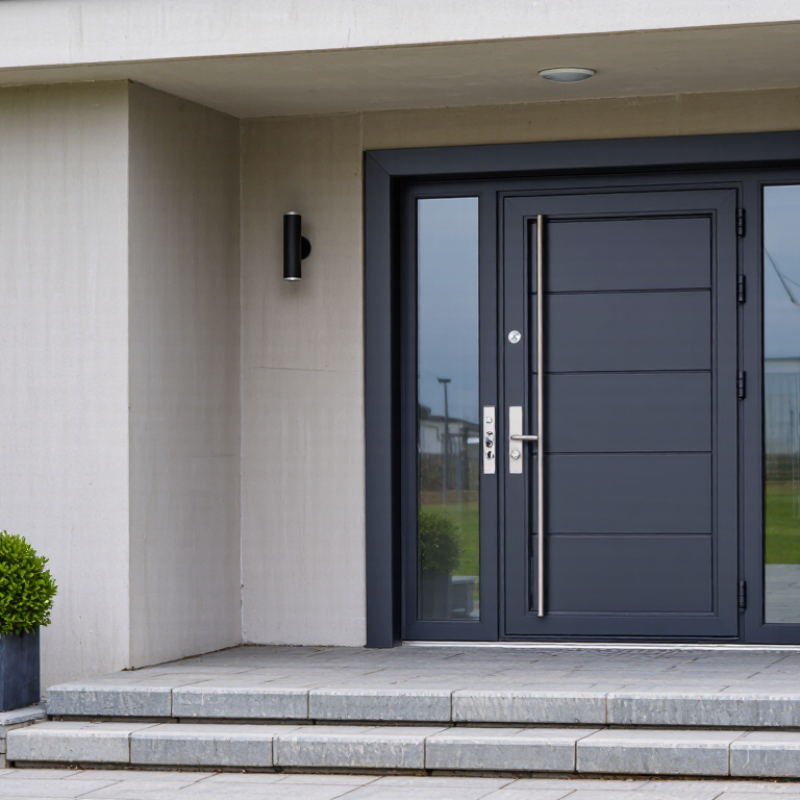
For many China aluminum entrance doors, 6063-T5 is a practical frame alloy. It extrudes smoothly, which helps create clean grooves, narrow edges, and accurate corner joints. Its surface also accepts anodizing or powder coating evenly. This matters at the doorway, where fingerprints, rain, and strong sunlight quickly expose weak finishing work.
6063-T5 offers a useful balance of strength, appearance, and production cost. T5 means the extrusion is cooled after shaping and artificially aged for improved hardness. A well-made frame should feel firm when the door closes. The corners should remain square, without visible gaps or movement. Small details matter.
Still, 6063-T5 is not a magic alloy. Very large doors, heavy glass, or high-wind locations may require thicker profiles or a stronger alloy, such as 6061. The alloy alone cannot guarantee quality. Wall thickness, thermal breaks, drainage holes, hardware fixing, and installation accuracy are equally important. A beautiful sample can hide poor internal reinforcement.
Check the profile cross-section before ordering. Ask for alloy certification, coating specifications, and dimensional tolerances. Test the locking side for deflection. Also inspect the bottom rail after rain simulation. These checks may feel excessive, but entrance doors receive daily abuse. For most residential frames, 6063-T5 remains a sensible starting point, provided the design and fabrication are properly controlled.
What Is the Best China Aluminum Entrance Door?
Thermal Performance: Compare U-Values Below 2.0 W/m²·K for Energy Saving
A high-quality aluminum entrance door should be judged by its whole-door U-value, not its frame alone. Values below 2.0 W/m²·K indicate stronger resistance to heat transfer. The lower, the better.
The Passive House Institute sets 0.80 W/m²·K as a demanding reference for certified door components. Most projects do not need that extreme target. However, it shows why a 1.8 W/m²·K entrance door can perform better than a basic metal door. Low-conductivity polyamide breaks, insulated panels, and correctly sealed glass help reduce heat loss. The European standard EN ISO 10077-1 also supports calculating frame and glazing performance separately before assessing the complete door.
Look at the details.
In practical inspections, cold edges often appear near thresholds, corners, and lock areas. A laboratory result can miss installation problems. The U.S. Department of Energy explains that air leakage and thermal bridging strongly affect real building performance. Therefore, request a tested whole-door value, test conditions, and installation guidance. Ask whether the result covers the threshold and hardware.
A U-value under 2.0 W/m²·K is a sensible purchasing filter, but not the only one. I have seen attractive specifications weaken after poor sealing. That is the uncomfortable part. A careful comparison should include frame depth, gasket continuity, drainage design, and measured air permeability.
| Door Configuration | Frame and Panel Construction | Glazing Specification | Typical Whole-Door U-Value (W/m²·K) |
Thermal Performance | Best Use |
|---|---|---|---|---|---|
| Basic insulated aluminum entrance door | Thermally broken aluminum frame with a 60 mm insulated panel and continuous perimeter gaskets | Solid panel; no glazing | 1.8–2.0 | Meets the below-2.0 target at the lower end | Mild climates and sheltered residential entrances |
| Energy-saving glazed aluminum door | Thermally broken aluminum frame with an insulated lower panel and multi-point compression seals | Double insulating glass, approximately 24 mm overall thickness, low-emissivity coating, argon fill | 1.5–1.8 | Good balance between daylight and heat retention | Most residential applications in moderate climates |
| High-performance residential entrance door | Thermally broken aluminum frame with reinforced insulated panel, insulated threshold, and three sealing levels | Triple insulating glass, approximately 36 mm overall thickness, low-emissivity coatings, argon fill | 1.1–1.5 | Strong reduction of heat transfer through the complete door | Cold climates and energy-efficient homes |
| Premium full-panel aluminum door | Deep thermally broken frame with a 75–90 mm insulated door leaf, insulated edge zones, and low-conductivity threshold | Solid insulated panel; optional narrow vision panel | 0.8–1.2 | Very high thermal insulation with limited glazing area | Cold climates, passive-house-oriented designs, and north-facing entrances |
| Large-format glazed entrance door | Thermally broken aluminum frame with reinforced corner construction and adjustable compression hardware | Triple insulating glass with warm-edge spacer, low-emissivity coatings, and argon fill | 1.3–1.8 | Efficient when the glazing ratio and frame size are properly controlled | Modern homes requiring a wider glazed entrance |
| Entrance door with sidelights | Thermally broken frame system with insulated door panel, insulated mullions, and continuous weather seals | Triple insulating glass in the door and sidelights; low-emissivity coating and argon fill | 1.4–1.9 | Can remain below 2.0 with thermally improved glass and mullions | Wider entryways where daylight is important |
Technical note: U-values indicate heat transfer through the complete door assembly, including the frame, leaf, glazing or panel, and threshold. Lower values indicate better thermal insulation. Actual performance depends on door size, glazing ratio, frame design, threshold, seals, installation quality, and test conditions. Always request a whole-door test report based on EN ISO 10077-1 or an equivalent recognized method rather than relying only on the center-of-glass or panel U-value.
Security starts with measurable construction, not a polished catalog image. The 2023 FBI Crime Data Explorer recorded 847,522 burglary offenses in the United States, reminding buyers that entry resistance still matters. For a China aluminum entrance door, I would request tested 1.5–2.0 mm aluminum profiles, especially around the frame, hinge side, and lock chamber. Thicker metal can reduce flexing, but 2.0 mm alone is not proof of security. That conclusion is tempting, and incomplete.
The lock system deserves equal attention. A multipoint lock should engage securely at several points, while concealed or protected hinges reduce exposed attack areas. Ask for cycle-test results, cylinder specifications, and independent laboratory evidence. EN 1627 resistance classifications can help compare complete doors, although a certificate for one configuration may not cover every size or installation method. Installation remains the weak link surprisingly often.
Laminated glass adds another protective layer. Interlayers hold broken pieces together, rather than allowing immediate passage through a shattered panel. For entrance doors, specify the actual glass build-up, such as two panes with a structural interlayer, not simply “safety glass.” ASTM and EN testing methods measure impact performance differently, so the test standard should accompany the rating. In practice, I would inspect corner joints, anchoring depth, and the threshold before purchase. Small details matter. And yes, even a strong door can perform poorly when the surrounding wall is weak.
What Is the Best China Aluminum Entrance Door?
For an aluminum entrance door, weather resistance starts with the surface finish. I have inspected doors after rainy seasons and found weak coating around corners, hinges, and drainage holes. A durable powder coating should usually measure 60–80 μm after curing. Use a calibrated coating thickness gauge, not visual judgment alone.
Look closely at the frame edges. Thin spots can expose aluminum to moisture, dirt, and coastal salt. Ask for recorded measurements from several areas, including the lower rail. The coating should also show consistent color, strong adhesion, and no bubbling or peeling. A basic cross-cut adhesion test can reveal poor bonding. It is not perfect, but it provides useful evidence.
Water-tightness testing matters just as much. A qualified supplier should simulate heavy rain with controlled spray and pressure. Inspectors should check the frame joints, glass seals, threshold, and lock area for leakage. Drainage channels must release water quickly, rather than hold it against the door gasket. Request test conditions, duration, photos, and signed records. Some sellers provide only a general certificate, which is not enough for careful comparison. I would also inspect a production sample, because laboratory performance can differ from installation results. Small alignment errors often appear on site. The best door is not simply the thickest or most expensive option. It is the one with measurable coating quality, tested seals, and consistent factory control.
Choosing the best China aluminum entrance door starts with supplier verification, not appearance. GB/T 8478 compliance should be checked against the current standard edition, product type, and tested configuration. Ask for the complete laboratory report, not only a certificate. It should identify air permeability, watertightness, wind-pressure resistance, thermal performance, hardware, and test conditions. The tested frame, glass, seals, and locking system must match the proposed door. Otherwise, the document may describe a stronger sample.
Look closely at the testing laboratory and report number. Independent accreditation adds credibility, but it does not replace production inspection. Request batch records, profile alloy information, coating thickness, and dimensional tolerances. The International Energy Agency’s Buildings 2023 report states that buildings consume about 30% of global final energy. A poorly sealed entrance can increase drafts and operating costs, even when its aluminum profile looks premium. Small gaps matter.
Warranty language deserves equal attention. Confirm separate coverage periods for the frame, surface finish, glass, seals, hinges, locks, and installation. Define response time, replacement responsibility, and exclusions for coastal corrosion or improper adjustment. Some suppliers promise ten years, yet explain little about labor or hardware. That is a warning. I would also inspect one installed sample after rain and repeated opening. Reports are useful. Real doors can still disappoint. Supplier claims need practical questioning.
GB/T 8478 provides a framework for aluminum door and window terminology, product requirements, performance testing, inspection, marking, packaging, transport, and storage. It does not establish a universal warranty duration or after-sales policy, so those terms must be confirmed directly in the supplier’s contract.
Request 1.5–2.0 mm aluminum profiles, especially around the frame, hinges, and lock chamber. Thicker is not everything.
Look for multipoint locking that engages at several points. Protected hinges can reduce exposed attack areas. Ask for cycle-test results, cylinder details, and independent laboratory evidence.
Not necessarily. A test may cover one size, glass type, or installation method only. Check whether the tested configuration matches your actual door.
Its interlayer holds broken pieces together after impact. This can reduce immediate passage through the panel. Specify the glass build-up, not merely “safety glass.”
Check corner joints, anchoring depth, the threshold, and the surrounding wall. A strong door may perform poorly against a weak wall. Installation is often underestimated.
A cured coating of about 60–80 μm is commonly requested. Use a calibrated thickness gauge across corners, hinges, drainage holes, and the lower rail. Visual inspection is not enough.
Look for consistent color, firm adhesion, and no bubbling or peeling. A cross-cut adhesion test can reveal weak bonding. It is useful, but not perfect.
Request controlled heavy-rain testing with recorded pressure and duration. Inspect frame joints, glass seals, the threshold, and the lock area. Drainage channels should release water quickly. Small alignment errors appear on site.
Ask for test conditions, photographs, signed records, coating measurements, and production samples. A general certificate may provide too little detail. I would still inspect the actual sample.
Choosing the best China Aluminum Entrance Door requires evaluating more than appearance and price. For most entrance door frames, 6063-T5 aluminum alloy offers a practical balance of strength, corrosion resistance, machinability, and finish quality. Energy efficiency is also important, so compare tested U-values and prioritize designs below 2.0 W/m²·K when improved insulation is needed. Security should be assessed through several components, including 1.5–2.0 mm profile thickness, reliable locking systems, reinforced hardware, and laminated glass that can improve impact resistance and safety.
For long-term performance, examine the powder coating thickness, with approximately 60–80 μm providing a useful reference for surface protection, and request evidence of water-tightness testing. Supplier reliability matters as well: verify compliance with GB/T 8478, review structural and performance test reports, and clarify warranty terms, installation support, and after-sales responsibilities. A well-chosen Aluminum Entrance Door should combine durable materials, thermal efficiency, secure construction, weather resistance, and transparent quality documentation.

Luxfront